
Surveying a Grade I Listed Church in Shoreditch for a Food Hall Conversion
A RICS Schedule of Condition on St Michael and All Angels, Leonard Street, Shoreditch: a Grade I Victorian Gothic church becoming a food hall.
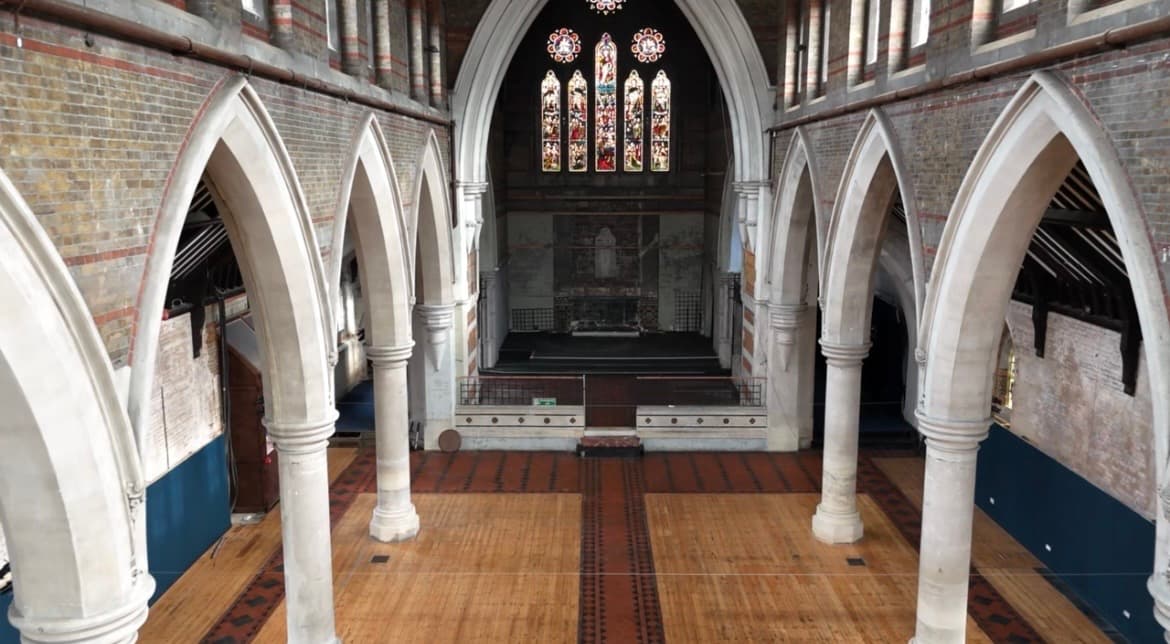
Not every instruction involves a three-bed semi. Sometimes you find yourself standing in the nave of a 160-year-old Gothic church, torch in hand, looking up at an original timber roof structure while pigeons watch from the gallery above.
Our client, a food hall operator, approached us to carry out a RICS Schedule of Conditions survey on St Michael and All Angels Church at 74-76 Leonard Street in Shoreditch. They were in the process of acquiring the site and needed an independent, photographic record of the building's condition before entering into a lease. That record protects both parties: the incoming tenant has a baseline to reference at lease end, and the landlord has documented proof of the state they handed the property over in.
The building
St Michael and All Angels is one of just six Grade I listed buildings in the London Borough of Hackney. It was designed by James Brooks, one of the most prominent Gothic Revival architects of the Victorian era, and completed in 1865. Brooks built his reputation on a series of monumental East End churches, and St Michael's was his first major commission. The building could originally seat a congregation of 1,000.
The church was deconsecrated in 1964 and spent the next five decades in commercial use, most notably as the home of LASSCO and later Westland London, two of London's best known architectural salvage dealers. That chapter ended in 2019, and the building has since been the subject of conversion proposals.
Why conversions like this are becoming more common
Across central London, and particularly in areas like Shoreditch, Old Street, and the City fringe, the conversion of heritage buildings into commercial, hospitality, and mixed-use spaces has accelerated. Churches, warehouses, former schools, and industrial buildings are being repurposed rather than demolished. The economics make sense for developers (the structures are often sound and the locations are prime), and the planning framework increasingly favours sensitive adaptive reuse over new build on heritage sites.
For operators looking to acquire these spaces, the appeal is obvious: a Victorian church nave with original stonework, stained glass, and timber roof framing is a setting that no new build can replicate. But the due diligence required is proportionally more involved. You are not just taking on a commercial lease. You are inheriting a building with 160 years of wear, multiple phases of alteration, and listed building constraints on what you can and cannot change.
What the survey found
Our team inspected the property on 9 March 2026. The schedule ran to over 100 photographs documenting the condition of every accessible area, from the nave and aisles down to the cellar vaults beneath the building.
The building's primary structure, the stone arches, columns, and load-bearing walls, is largely intact. That's the good news. But the interior tells the story of a building that has been without sustained maintenance for some time.
Key findings included structural cracking to internal masonry walls in several locations, particularly to the rear elevation. The original timber roof structure, while visually impressive, showed areas of deterioration to the underlying roof materials, with missing tiles and temporary plywood patches in places. Internally, the limewash finish to the brickwork and stonework had deteriorated extensively, and the original terracotta floor tiles showed significant wear.
At cellar level, we found standing water, deteriorated brickwork from prolonged water ingress, and defective cast-iron downpipes at street level that were the likely source of the moisture penetration. Vermin activity was noted in multiple areas. The electrical installations, spread across several distribution boards in the cellar, will need full assessment by a specialist before any fit-out works begin.
Why the schedule of condition matters here
For a food hall operator entering into a lease on a Grade I listed building, the schedule of condition is not a nice-to-have. It is essential.
Without a photographic and written record of the building's condition at lease commencement, the tenant has no protection against dilapidations claims at lease end. If a crack was there before you moved in but you have no evidence of it, you could find yourself liable for its repair when you leave. On a building of this scale and heritage significance, repair costs can be substantial.
For our client, the schedule of condition was the first phase of a wider instruction. We are continuing to assist with the planning application, valuation, and fit-out advisory as the project moves forward. Having one practice involved from acquisition through to completion means continuity of knowledge across every stage.
The schedule also informs the tenant's fit-out budgeting. Knowing that the roof has temporary patches, the cellar has water ingress, and the electrics need replacing means you can price those items into your acquisition costs rather than discovering them after you have committed.
Shoreditch and the City fringe
Leonard Street sits in the heart of Shoreditch's commercial core, a few minutes' walk from Old Street station and within the South Shoreditch Conservation Area. The surrounding streets have seen significant development over the past decade, with former industrial and ecclesiastical buildings converted into offices, restaurants, and cultural venues.
For surveyors, this part of east London presents a particular mix of challenges: listed buildings with complex construction histories, mixed-use conversions where commercial and residential obligations overlap, and a pace of development that means buildings change hands frequently. Having a practice that understands both the heritage context and the commercial reality is essential.
Planning a commercial acquisition in London or the South-East? A Schedule of Conditions survey protects your position from day one. Get in touch to discuss your instruction →
Areas covered
Free · No obligation
Get a quote for your property
RICS regulated surveyors across London and the South-East. For most surveys the fee shows on screen before you share any contact details.