
London clay subsidence in South-East London
Why London clay subsidence shows in dry summers, and what to spot on a South-East London survey before exchange.
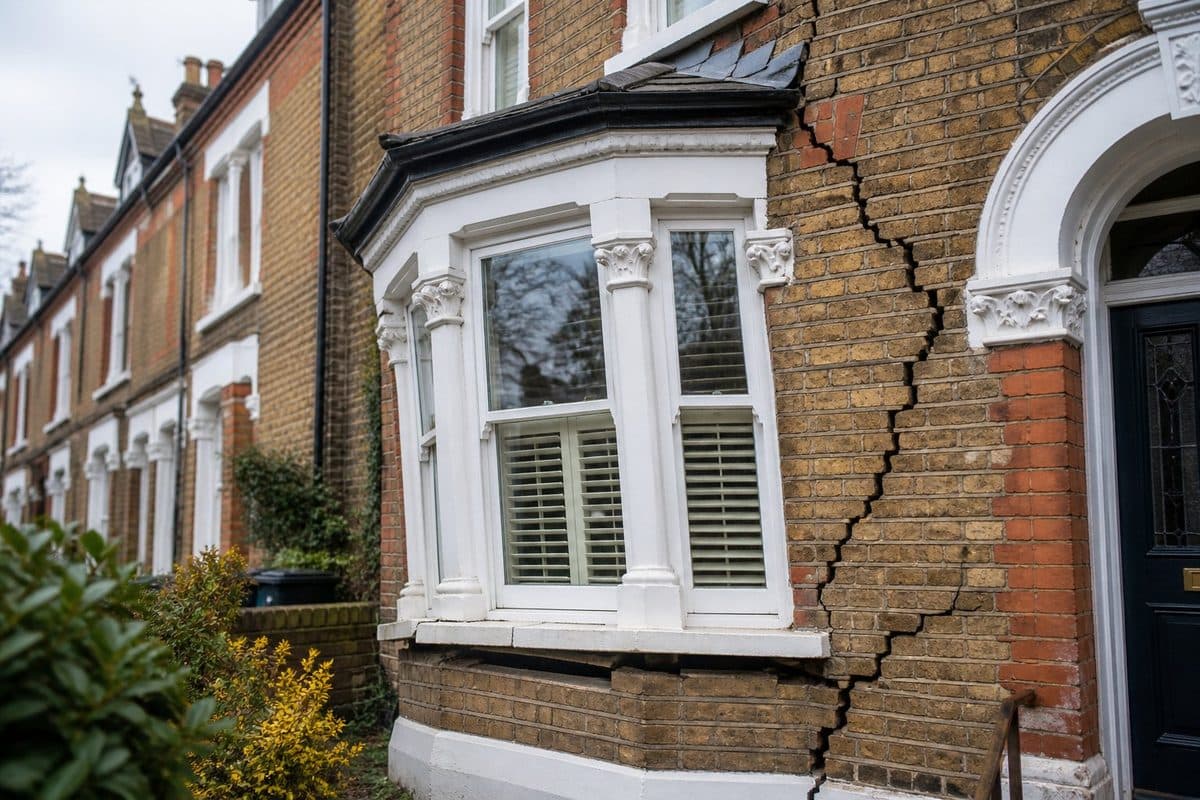
Summer is when South-East London's geology starts asking questions of its housing stock. Most of the SE postcodes sit on the London clay belt, a soil that shrinks measurably in dry weather and swells back in winter. Period properties with shallow Victorian foundations have been riding that cycle for over a century, and by July or August the cracks usually have something to say.
For buyers, the timing matters. A property inspected in February can show very different signs to the same property in late August. If you are exchanging this summer on a SE London terrace, semi, or conversion, here is what we look for and how we read it.
Why South-East London is more exposed than most
The London Basin's clay layer reaches its thickest deposits in the south and east of the capital. Greenwich, Lewisham, Catford, Forest Hill, Brockley, Peckham, Dulwich, Eltham, and Sidcup all sit on substantial clay. When summers run dry, the soil contracts. Foundations laid before modern building regulations, often less than a metre deep on Victorian and Edwardian terraces, follow the soil down. When autumn rains return, the clay swells and pushes back up. Properties have lived with this for decades. The damage shows up at the seams.
Three factors compound the baseline geology and make a SE London property more vulnerable:
- Mature trees within influencing distance. Oak, willow, poplar, and London plane all draw heavily on soil moisture. Their root influence extends roughly to their height, sometimes further on heavy clay.
- Drainage failures. Leaking drains soften clay locally, creating differential movement. The older Victorian drainage runs across SE London are a recurring source of this.
- Recent extensions or additions. New foundations next to old ones rarely move at the same rate. The junction is where cracks open up.
What summer adds to the picture
The drought summers of recent years (2018, 2022) drove a measurable spike in subsidence claims across the SE postcodes. Even an average summer pulls enough moisture out of the clay to expose properties that were borderline. By late summer, hairline cracks that would have been invisible in winter have widened enough to read.
This is why a survey carried out in August or September on a clay-belt property can be more diagnostically useful than one in March. The building is showing you what it does under stress.
The patterns we see most often
Not all cracks mean subsidence. Most are cosmetic, caused by plaster shrinkage, thermal movement, or settlement of new finishes. The patterns that warrant attention are:
- Stepped cracking through brickwork, particularly at the corners of bay windows and around door and window openings. These follow the mortar joints in a diagonal staircase pattern.
- Diagonal cracks running from window corners outward and upward. Window and door openings are weak points where stress concentrates.
- Bay windows pulling away from the main facade. Bays are often built on shallower foundations than the main wall and are first to move.
- Internal cracks that mirror external ones. A crack visible on both sides of a wall is structural until proven otherwise.
- Sticking doors and windows, particularly if the issue is recent and seasonal.
- Cracks wider than 3mm, or cracks that have visibly grown between viewings.
Hairline cracks under 1mm in plaster, on their own, are usually not the problem. Crack pattern, location, and propagation matter more than width alone.
What our team checks on site
When we inspect a SE London property with any of the above signs, the assessment goes beyond visual measurement. Our team looks at:
- Crack widths at multiple points along the same line, to establish whether movement is uniform or differential
- Internal and external alignment, to confirm whether the crack passes through the structure
- Tree species, size, and distance from the property, mapped against the clay's likely shrinkage zone
- Visible drainage runs, gully condition, and any signs of leakage near the affected elevation
- Recent extensions, conservatories, or rear additions and their junction with the original structure
- Floor levels internally, using a digital level where movement is suspected
- Roof line and ridge level externally, sighted against neighbouring properties
This builds a picture of whether what you are seeing is historic, stable movement (the property has cracked, settled, and stopped) or progressive movement that needs structural attention before exchange.
When a Level 2 is enough, and when it isn't
For most SE London properties without visible distress, a RICS Level 2 Homebuyer Survey gives you the information you need to proceed. The surveyor inspects what is visible and accessible and flags anything requiring further investigation.
If the property shows any of the patterns above, or if there is documented history of subsidence, underpinning, or insurance claims, we recommend a RICS Level 3 Building Survey. The Level 3 includes a more detailed structural assessment, opens up specific areas of concern, and gives you the depth needed to negotiate with confidence or walk away.
For a fuller breakdown of when each level is appropriate, see our guide on Level 2 vs Level 3 surveys.
For very specific concerns, a Specific Defect Survey can focus solely on the cracks, their cause, and the remedy. This is often the right call when a Level 2 has flagged something and you need a clear answer before committing.
What to do if you've spotted cracks before exchange
The instinct is to panic. The better move is to slow down for forty-eight hours and get the right information. Three steps in order:
- Photograph the cracks with a ruler or coin for scale, ideally at multiple points along the same crack and from both sides of the wall where possible.
- Ask the vendor for any history of subsidence claims, monitoring reports, or underpinning works. This is a fair question and the answer is informative either way.
- Commission the right level of survey. If you are already booked for a Level 2, talk to your surveyor about whether the findings warrant escalation to a Level 3 or a Specific Defect Survey before the report is finalised.
Subsidence is a manageable issue when it is identified early and assessed properly. It becomes an expensive surprise when it is missed at survey stage and emerges six months after completion.
Local context matters
Every SE London neighbourhood has its quirks. The Victorian terraces of Lewisham and Catford behave differently to the Edwardian semis of Eltham, which behave differently again to the conversion stock around Greenwich and Blackheath. Knowing the local pattern, the typical foundation depths, the soil movement history, and the drainage characteristics of a specific street is what separates a useful survey from a generic one.
If you are buying in South-East London this summer, see our coverage of the area and book a survey here. Our team has completed surveys across all SE postcodes recently, including L2, L3, and Specific Defect work on properties showing exactly the patterns described above.
Areas covered
Free · No obligation
Get a quote for your property
RICS regulated surveyors across London and the South-East. For most surveys the fee shows on screen before you share any contact details.