
Your First Home: the 2.5% deposit scheme explained, with the numbers for a London buyer
The 2.5% deposit, 20% equity loan scheme: what is confirmed, what waits for the 28 October Budget, and a calculator for your own numbers.
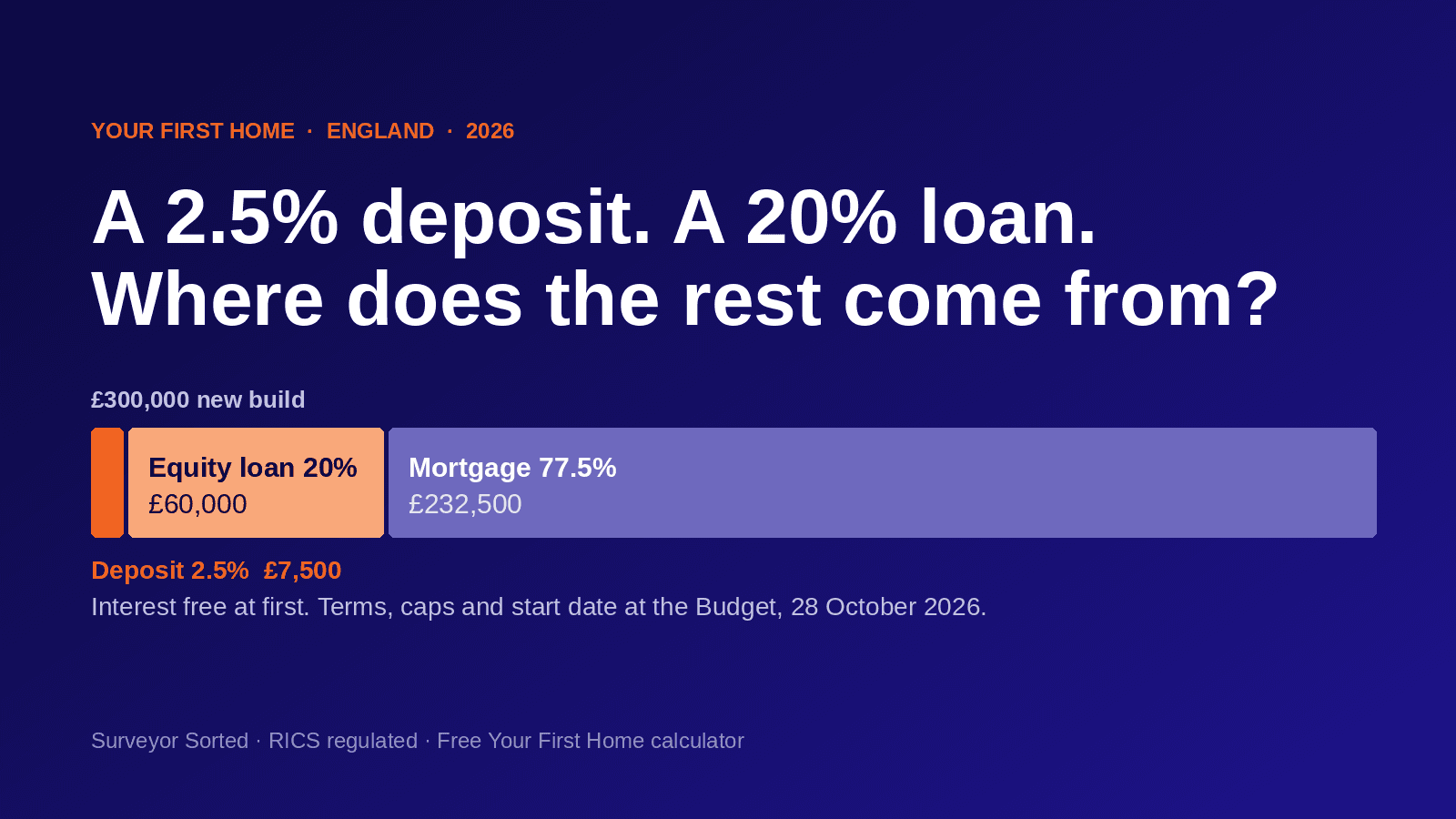
The Prime Minister used the run up to Labour's conference in Liverpool to announce a new equity loan scheme for first-time buyers. It is called Your First Home, and the headline is a 2.5% deposit. Housebuilder shares rose by between 10% and 15% on the Monday morning. Everything else, from the interest terms to the start date, waits for the Budget on 28 October. Here is what has been confirmed, what has not, and what the numbers look like for a buyer in London and the South East.

What has been announced
The scheme was announced on 26 September 2026 by Andy Burnham, who became Prime Minister in July, with Housing Secretary Angela Rayner. It applies to first-time buyers in England buying a new build home. The buyer needs a deposit of at least 2.5% of the price. The government provides an equity loan of 20% of the price, interest free for an initial period. A mortgage from a normal lender covers the remaining 77.5%.
Three further points are confirmed in outline only. There will be a household income cap and local property price caps, so the scheme is aimed at people with a steady income and no family money rather than higher earners. Housebuilders that join will make a financial contribution towards the scheme's costs. The rest is funded by reprioritising existing budgets. Chancellor John Healey will set out the detail, including the length of the interest free period and the caps, in the Budget on 28 October.
The Prime Minister's line was that too many young people are giving up hope of a home of their own, and that the scheme is for those who cannot call on the bank of mum and dad. The Shadow Housing Secretary, Katie Lam, called it a colossal admission of failure and said the government had made homes harder to build and was now asking buyers to borrow more to pay for them.
What has not been announced
It is worth being precise about the gaps, because they decide whether the scheme is any use to a particular buyer.
- The interest free period. Help to Buy gave five years, and most commentary assumes the same, but the government has only said "initially". Five years is the sensible working assumption, not an announcement.
- The charge after that. Help to Buy charged 1.75% of the original loan from year six, rising each year with inflation plus 1%. Nothing has been published for the new scheme.
- The income cap and the price caps. Both are confirmed to exist, neither has a figure. Help to Buy's only ceiling was £600,000, which is why it worked in London.
- Whether there is an age limit. Ministers had not confirmed one when asked.
- The start date. None given. Nobody can apply yet.
Anything you read that fills those gaps with numbers is guessing, including our calculator below, which says so on the page.
The 2.5% is the deposit, not the rate
Some of the early coverage has muddled this. The scheme does not give anyone a 2.5% mortgage. The mortgage is a normal loan at whatever rate the lender sets for a 77.5% loan to value, which today is broadly the 4% to 5% range depending on the fix. The 2.5% is the cash the buyer puts in. On a £300,000 home that is £7,500. Under Help to Buy it was £15,000. For a buyer saving from a salary while paying London rent, that halving is the whole point.
A worked example, and your own
Take a £300,000 new build, which is a realistic price for a one or two bedroom flat on a new scheme in outer London or a house in the wider South East. The split is £7,500 deposit, £60,000 equity loan and a £232,500 mortgage. At 5% over 30 years, which is where the best five year fixes at 80% loan to value sat on 29 September (Halifax 5.02%, HomeOwners Alliance tables), the mortgage costs about £1,248 a month.
The comparison that matters is not the Help to Buy buyer of 2019 but the same person today without the scheme. A 95% mortgage on the same home needs £15,000 down and £285,000 of borrowing, and 95% deals are priced higher: the best five year fix on 29 September was NatWest at 5.54%, and two year fixes were around 5.6%. At 5.55% that is about £1,627 a month. The scheme therefore saves roughly £380 a month while the loan is interest free, and £7,500 up front.

The cost arrives later. The equity loan is repaid as 20% of the home's value at the time, not 20% of what was borrowed. If the flat is worth £331,000 after five years of 2% growth, the loan to repay is £66,250, which is £6,250 more than was borrowed. Run the numbers for your own price and rate here.
The calculator uses the Help to Buy terms for the loan, five years interest free and then 1.75% a year, because that is the only precedent, and says so beside the figure. We will update it when the Budget fills the gaps in.
What the Help to Buy years tell us

Help to Buy ran from 2013 to 2023 and financed more than 387,000 purchases, 328,000 of them by first-time buyers. The government's own evaluation found it effective at getting people into home ownership in some areas but said it did not remove the affordability barrier in areas that were already expensive, which is a fair description of most of London. The National Audit Office put the new build premium at 15% to 20% over an equivalent second hand home, and found that a good share of Help to Buy users could have bought without it.
Three lessons carry over. First, the new build premium is real and is larger than the deposit. A buyer with 2.5% equity in a home that carries a 15% premium is relying on the wider market rising before they can sell without a loss. Second, price caps create cliffs: developers price to the cap, and the cap becomes the price. Third, the loan is cheap while it is interest free and then it is not, and the resale or remortgage that clears it needs an independent valuation at that point.
The London question
Help to Buy in London was a 40% loan with a £600,000 ceiling, because a 20% loan did not close the gap on London prices. Your First Home has been announced as a 20% loan everywhere with local caps to be set. If the London cap lands anywhere near the national average price, the scheme will cover a minority of the capital's new build flats, and the income cap will bite on the dual income households who can afford the rest. Neil Leitch of Hampshire Trust Bank made the same point on the day: caps set nationally risk locking out Londoners where values are about twice the national figure. Until 28 October that is an open question, and the answer will decide whether this is a South East scheme or a national one.
What a buyer should do now
Nothing can be applied for yet, so the useful preparation is the ordinary kind. Get a decision in principle so you know what a lender will offer on a 77.5% loan, which is more than most 95% products. Look at new build schemes in the price band you expect the cap to cover, and compare the asking prices with second hand homes of the same size nearby, because that gap is the premium you are being asked to pay. If you already own a Help to Buy home and are thinking about repaying the loan before this changes the market, the redemption needs a RICS valuation, which is something we do.
When you are ready to buy, a new build is not exempt from a survey. Warranties cover structural failure, not the long list of defects that a snagging inspection or a Level 2 survey finds before you complete, and a buyer with 2.5% equity has less room than anyone to absorb a problem after the keys are handed over.
Figures in this article come from the government announcement of 26 September 2026 and reporting by PA Media, the BBC, the Guardian, Sky News, LBC, the Independent, Housing Today, IFA Magazine and Property Industry Eye, with Help to Buy data from the government's evaluation and the National Audit Office. Mortgage rates are illustrative. Nothing here is mortgage or financial advice.
Quick answers
Frequently asked questions
- What is the Your First Home scheme?
- A government equity loan scheme for first-time buyers in England, announced by Prime Minister Andy Burnham on 26 September 2026. The buyer puts down a deposit of at least 2.5%, the government lends 20% of the price of a new build home as an equity loan that is interest free at first, and a mortgage covers the rest, about 77.5%. Full terms come at the Budget on 28 October 2026.
- How is Your First Home different from Help to Buy?
- The shape is the same: a 20% equity loan on a new build, interest free to begin with, repaid as a share of the home's value. The deposit is halved from 5% to 2.5%, there will be a household income cap and local price caps, which Help to Buy did not have beyond its £600,000 ceiling, and housebuilders will pay towards the scheme's running costs.
- Is the 2.5% mortgage an interest rate?
- No. The 2.5% is the deposit, not the rate. On a £300,000 home that is £7,500. The mortgage is a normal capital and interest loan from a lender at the lender's rate. The equity loan is the part that is interest free at first.
- How much would I pay each month under Your First Home?
- On a £300,000 new build with a 2.5% deposit, the mortgage is £232,500. At 5% over 30 years, which is where the high street five year fixes at 80% loan to value sat at the end of September 2026, that is about £1,248 a month. The same home on a 95% mortgage at 5.55% is about £1,627 a month, so the scheme saves roughly £380 a month while the loan is interest free. Our calculator lets you change every figure.
- What are the risks of a 2.5% deposit?
- Your own equity is 2.5% of the price, so a fall of that size wipes it out. New builds typically sell for 15% to 20% more than an equivalent second hand home, and Help to Buy buyers who sold early sometimes found the resale value below their purchase price. The equity loan is repaid as 20% of the value at the time, so if prices rise you repay more than you borrowed.
- When does Your First Home start?
- No start date has been given. The government says the details, including the interest free period, the income cap, the price caps and the developer contribution, will be set out at the Budget on 28 October 2026. Until then no lender or developer can offer it.
- Will Your First Home work in London?
- That depends on the price caps, which have not been published. Help to Buy had a £600,000 ceiling in London and a 40% loan there rather than 20%. Your First Home has been announced as a 20% loan with local caps, so a London cap set near the national average would exclude most of the capital's new build flats.
Areas covered
Free · No obligation
Get a quote for your property
RICS regulated surveyors across London and the South-East. For most surveys the fee shows on screen before you share any contact details.