Japanese knotweed and your mortgage in 2026
How Japanese knotweed affects a 2026 mortgage, the RICS A to D categories, and what a survey must record.
Local coverage
Victorian and Edwardian suburbs, interwar semis, and extensive regeneration along the Thames.
About the area
South East London covers Greenwich, Lewisham, Bexley, and Bromley, a belt of neighbourhoods that runs from the Thames down to the Kent border. The stock is dominated by Victorian and Edwardian terraces and semis in the inner areas (Greenwich, Blackheath, Lewisham, Brockley) and extensive 1930s suburban development further out. Greenwich itself retains a strong heritage character with significant listed building concentration.
Boroughs covered
Postcodes
SE3 · SE4 · SE6 · SE7 · SE8 · SE9 · SE10 · SE12 · SE13 · SE14 · SE18 · SE23 · SE26 · BR1 · BR2 · BR3 · BR4 · BR5 · BR6 · BR7 · BR8 · DA1 · DA5 · DA6 · DA7 · DA8 · DA14 · DA15 · DA16 · DA17 · DA18
Housing stock
Georgian houses in Blackheath and Greenwich, Victorian and Edwardian terraces through Brockley, Forest Hill, and Honor Oak, extensive 1930s semis across Bromley and Bexley, and post-war council estates in Thamesmead and Abbey Wood. Significant recent regeneration along the Greenwich peninsula and Woolwich waterfront.
Market context
South East London offers relatively good value compared to other quadrants of the capital, with strong transport links via the Elizabeth Line, DLR, and Southeastern services. The regeneration of Woolwich and Greenwich peninsula has driven new-build activity, while inner areas like Brockley, Honor Oak, and Forest Hill remain popular with families moving out of central London.
Market data
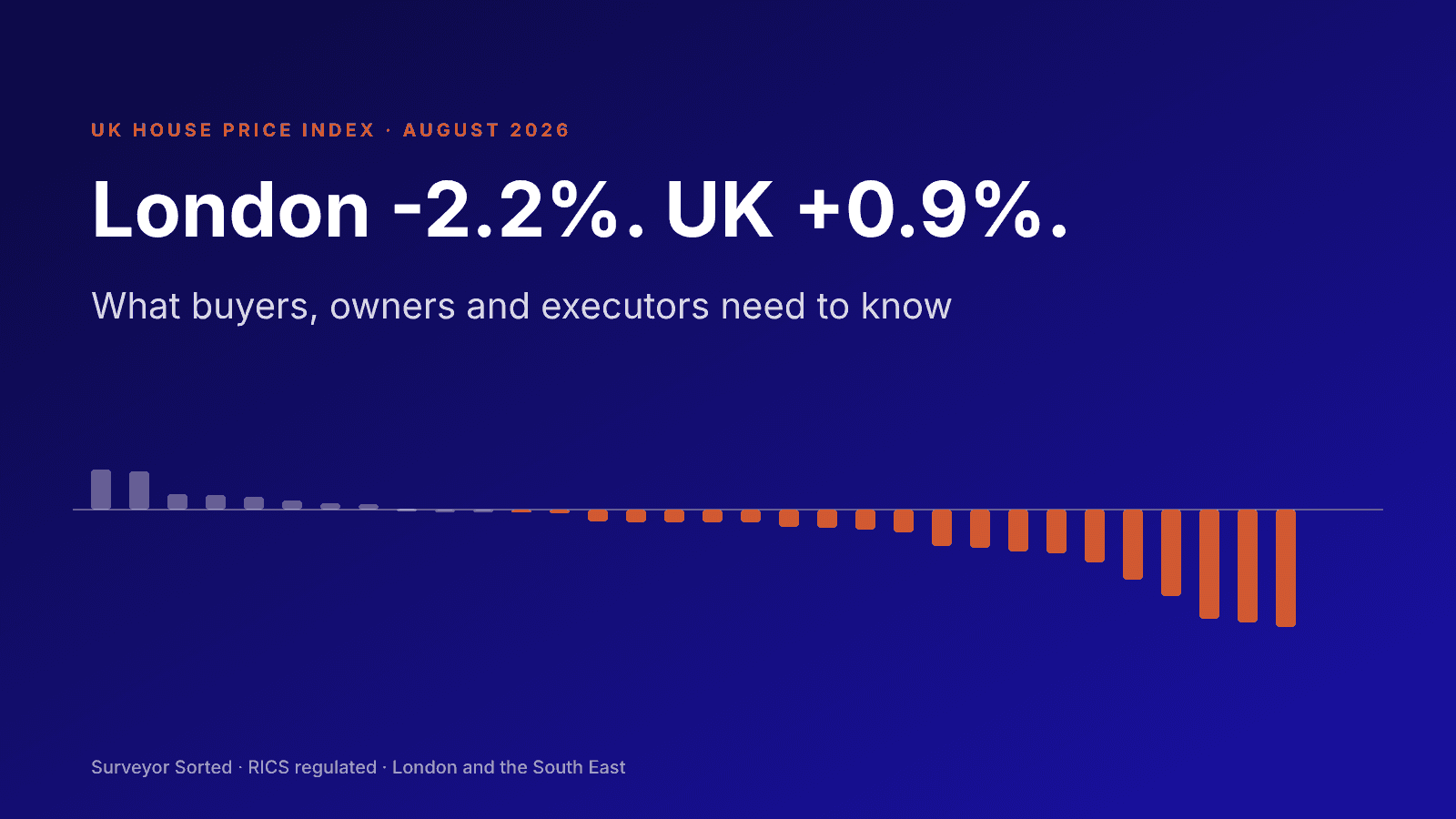
South East London is dominated by Victorian and Edwardian terraces, interwar semis in the outer boroughs, and a growing band of riverside regeneration stock from Greenwich out to Woolwich and Erith. Values have softened modestly over the past year, broadly in line with the wider London market, with the bulk of transactions falling in the £400,000 to £750,000 range. Lewisham, one of the area's most active boroughs, held roughly flat year on year at around £490,000. As across London, transaction volumes are well down on the prior year, so buyers face less competition while sellers are pricing carefully. Period-terrace condition issues remain the dominant survey concern. (Figures from HM Land Registry and ONS data, early 2026.)
What we often find
Subsidence risk in clay soil areas, particularly southern Bexley and Bromley
Aluminium window frames and original 1930s glazing requiring replacement
Historic flat roof failures on 1930s bay extensions
Damp and ventilation issues in Victorian basement conversions
Asbestos-containing materials in post-war housing stock
Neighbourhoods
From the field

How Japanese knotweed affects a 2026 mortgage, the RICS A to D categories, and what a survey must record.

Why London clay subsidence shows in dry summers, and what to spot on a South-East London survey before exchange.
Get a free, no-obligation quote for your survey. Same-day response, transparent pricing, and a report delivered within 3 to 5 working days of the inspection.